
Here’s a quick recap of the crypto landscape for Monday (April 27) as of 8:00 p.m. UTC.
Get the latest insights on Bitcoin, Ether and altcoins, along with a round-up of key cryptocurrencymarket news
Bitcoin (BTC) was priced at US$76,831.05, down by 1.8 percent over the last 24 hours.
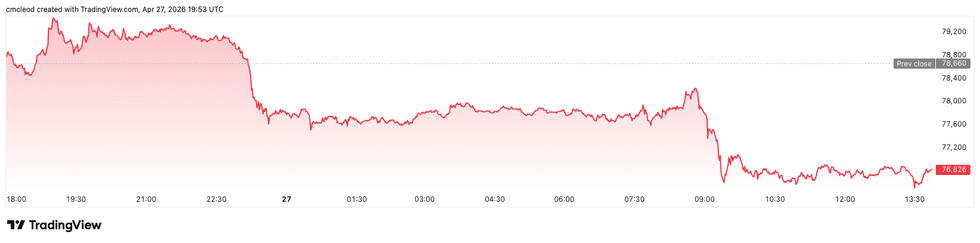
Chart via TradingView.
Bitcoin price performance, April 27, 2026.
Bitcoin is hovering below US$80,000 as traders brace for a massive week of macro and regulatory shifts.
The crypto industry’s attention is currently split between the high-profile Bitcoin 2026 conference in Las Vegas, and the US Federal Reserve’s impending interest rate decision later this week.
Newly appointed US Securities and Exchange Commission Chair Paul Atkins is slated to speak at the crypto conference, marking his first major public address on digital asset market structure since taking office.
Concurrently, the Fed’s two day policy meeting, which will wrap up on Wednesday (April 29), is poised to heavily influence near-term US dollar strength and broader risk appetite.
Ether (ETH) was priced at US$2,287.48, down by 3.4 percent over the last 24 hours.
Altcoin price update
- XRP (XRP) was priced at US$1.39, down by 2.7 percent over 24 hours.
- Solana (SOL) was trading at US$84.14, trading 3.2 percent lower over the past 24 hours.
Today’s crypto news to know
Tether launches open infrastructure layer for Bitcoin mining
Tether announced the launch of its Mining Development Kit (MDK), an open-source, full-stack framework designed to streamline and unify Bitcoin-mining operations.
The move follows Tether’s release of its Mining OS (MOS) operating system. The MDK component serves as a development framework that allows developers to build new applications, tools and custom versions of MOS.
Designed to be hardware-agnostic, meaning it will work regardless of the specific brands or models of miners being used, the framework consists of two primary layers.
The first layer, MDK Core, is an open-source software development kit with a JavaScript backend for real-time device control and customizability. The second layer, the UI Development Kit, consists of a library of React components used to build standardized dashboards and visual interfaces for monitoring operations.
“Infrastructure is at the core of any mining operation. MDK is creating the blueprint for a universally compatible mining infrastructure with unprecedented levels of programmability and scalability. From serving home miners to large enterprises, it has always been our mission at Tether to empower all those who mine Bitcoin with sovereignty and transparency,” said Tether CEO Paolo Ardoino in a press release.
“The next generation of mining will be centered around automation and optimization, and MDK will serve as the backbone driving this shift towards autonomous agents and workflows.”
Western Union readies Solana stablecoin, crypto card
Western Union Company (NYSE:WU) announced it is pivoting toward blockchain infrastructure with the upcoming launch of its Solana-powered stablecoin, USDPT.
Developed in partnership with Anchorage Digital Bank, the dollar-pegged asset is primarily designed to modernize institutional cross-border settlements across the company’s massive global agent network.
The legacy financial giant isn’t stopping at backend operations, however. It is also rolling out a new digital asset network to seamlessly bridge consumer crypto wallets with its physical retail locations worldwide.
Later this year, a consumer-facing “Stable Card” will debut in dozens of markets, allowing everyday users to spend their dollar-backed tokens globally.
EU drops hammer on Russian crypto sector
The EU is deploying a sweeping new sanctions package that targets the Russian crypto industry.
According to blockchain intelligence firm Chainalysis, this 20th round of sanctions marks a historic shift from designating specific individuals to blacklisting the whole sector. The new regulations explicitly forbid any EU citizen or institution from transacting with Russian centralized exchanges or decentralized finance protocols.
The enforcement net has also been widened to capture third-country virtual asset service providers, such as the Kyrgyzstani exchange Meer, which allegedly facilitated over US$93 billion in sanctioned volumes.
Furthermore, Russia’s own central bank digital currency and the ruble-backed RUBx stablecoin have been explicitly classified as tools designated for sanctions evasion.
Blockchain for Europe criticizes MiCA
In its Reforming MiCA for Euro Stablecoins report, Blockchain for Europe and co-authors Dr. Ulrich Bindseil, former director, general market infrastructure and payments at the European Central Bank, and Erwin Voloder, director, research and strategy at Blockchain for Europe, argue that the EU’s Markets in Crypto‑Assets Regulation (MiCA) is making euro‑denominated stablecoins very safe, but also less competitive than counterparts pegged to the US dollar.
The report cites several “regulatory Laffer curve” effects within MiCA, including: a ban on paying interest to holders; a mandate that 30 to 60 percent of reserves be held in bank deposits; and high compliance hurdles for EU-denominated tokens. The report calls for targeted alterations to MiCA’s rules on euro e‑money and asset‑referenced tokens to build a resilient, liquid and globally relevant euro stablecoin ecosystem.
Don’t forget to follow us @INN_Technology for real-time news updates!
Securities Disclosure: I, Meagen Seatter, hold no direct investment interest in any company mentioned in this article.
Securities Disclosure: I, Giann Liguid, hold no direct investment interest in any company mentioned in this article.
5 Stocks Our Experts Predict Could Double In the Next Year
By submitting your email, you'll also get a free pivot & flow membership. A free daily market overview. You can unsubscribe at any time.