
Here’s a quick recap of the crypto landscape for Friday (January 30) as of 12 noon UTC.
Get the latest insights on Bitcoin, Ether and altcoins, along with a round-up of key cryptocurrencymarket news
Bitcoin and Ether price update
Bitcoin (BTC) was priced at US$83,062.62, down by 4.5 percent over 24 hours.
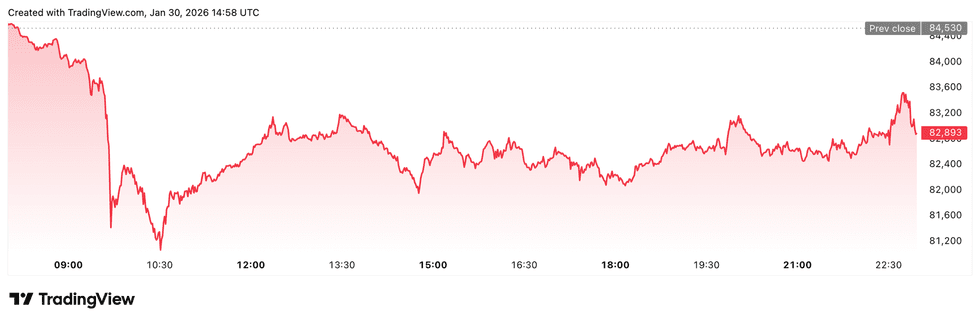
Chart via TradingView
Bitcoin price performance, January 30, 2025.
Ether (ETH) was priced at US$2,757.93, down by 5.0 percent over the last 24 hours.
Altcoin price update
- XRP (XRP) was priced at US$1.77, down by 3.6 percent over 24 hours.
- Solana (SOL) was trading at US$116.69, down by 3.7 percent over 24 hours.
Today’s crypto news to know
US Senate panel advances crypto market structure bill
A US Senate committee pushed the crypto market structure bill forward this week, marking the furthest the industry’s flagship policy effort has ever advanced in the chamber.
The legislation cleared the Senate Agriculture Committee on a narrow 12–11 vote, split strictly along party lines after Republicans chose to move ahead without Democratic backing.
Committee Chair John Boozman said months of negotiations had produced “significant progress,” arguing the bill was ready for its next stage despite unresolved disputes. Democrats opposed the markup as a bloc, warning the current text falls short on ethics safeguards and consumer protections.
Despite the progress, Ranking Democrat Amy Klobuchar said negotiations are not over and signaled openness to further talks as the bill advances. One of the sharpest flashpoints remains restrictions on senior government officials profiting from crypto ventures, an issue Democrats want written directly into the law.
The bill must still clear the Senate Banking Committee, where disagreements over stablecoin yield and regulatory scope have already delayed progress. Any final version would also need to reconcile differences with the House-passed bill before heading to the Senate floor.
SEC, CFTC launch joint push to unify crypto oversight
The Securities and Exchange Commission (SEC) and the Commodity Futures Trading Commission (CFTC) recently unveiled a joint initiative aimed at aligning rules for digital asset markets.
Speaking at CFTC headquarters, SEC Chair Paul Atkins said fragmented regulation has created confusion rather than protection for investors.
The effort, dubbed Project Crypto, is intended to reduce uncertainty over whether digital assets fall under securities or commodities law.
CFTC Chair Michael Selig said unclear jurisdiction has pushed innovation offshore, leading to firms exhibiting reluctance in US investment without regulatory clarity.
US Bitcoin, Ether ETFs suffer near-US$1 billion single-day outflow
US-listed spot Bitcoin and Ether ETFs saw nearly US$1 billion pulled in a single session as crypto prices slid and volatility surged.
Data from SoSoValue showed about US$818 million exiting bitcoin ETFs in one day, the largest daily outflow since November, while ether ETFs lost roughly US$156 million.
Bitcoin fell below US$85,000 during US trading before stabilizing, while Ether dropped more than 7 percent on the day. BlackRock’s IBIT led the redemptions, followed by heavy selling in Fidelity and Grayscale products.
Don’t forget to follow us @INN_Technology for real-time news updates!
Securities Disclosure: I, Meagen Seatter, hold no direct investment interest in any company mentioned in this article.
Securities Disclosure: I, Giann Liguid, hold no direct investment interest in any company mentioned in this article.
5 Stocks Our Experts Predict Could Double In the Next Year
By submitting your email, you'll also get a free pivot & flow membership. A free daily market overview. You can unsubscribe at any time.