
SoundHound AI, Inc. SOUN posted a record second-quarter 2025 with revenue up 217% year over year to $42.7 million. Beyond the financials, the company’s technology stack—anchored by its proprietary Polaris foundation model—is emerging as the core of its competitive moat in the generative AI race.
Polaris, trained on two decades of data, has consistently outperformed peers, with accuracy exceeding rivals by 35% and latency improvements of 4X. By replacing third-party dependencies, Polaris not only reduces costs but also accelerates customer adoption. This differentiation has driven higher renewal rates, expansions, and faster deal closures across verticals from automotive to restaurants.
SoundHound is also pushing into Vision AI, bringing real-time visual understanding into conversational systems. The integration of voice and vision AI marks a significant shift, enabling multimodal interactions for enterprise, automotive, and retail customers. Coupled with its agentic AI platform Amelia 7, SoundHound is positioning itself at the forefront of practical GenAI deployment.
The strategic upside is clear: as Voice Commerce pilots gain traction, the company is building an ecosystem where QSRs, automakers, and merchants converge on one platform. With Polaris scaling and Vision AI broadening applications, SoundHound is steadily crafting a defensible moat in GenAI—one that could secure long-term leadership if execution matches ambition.
Tech Giants Threatening the Moat
While SoundHound is advancing Polaris and Vision AI, it must contend with Amazon AMZN and Alphabet’s Google GOOGL, both of which are formidable rivals in conversational and generative AI.
Amazon continues to expand Alexa and AWS AI offerings, embedding voice and vision capabilities into consumer and enterprise ecosystems. For restaurants and QSR operators, Amazon’s established footprint in cloud services and retail integration creates a natural overlap with SoundHound’s ambitions. If Amazon deepens its push into voice commerce, it could directly challenge SoundHound’s ecosystem.
Google is equally significant with its Dialogflow and advanced natural language platforms. Google’s AI already powers millions of customer interactions globally, and the integration of multimodal vision with its generative AI tools aligns closely with SoundHound’s strategy. Google’s cloud dominance gives it a distribution edge, raising competitive stakes.
SOUN’s Price Performance, Valuation and Estimates
SoundHound shares have gained 60.2% in the past three months against the Zacks Computers – IT Services industry’s 7.8% decline.
SOUN Price Performance
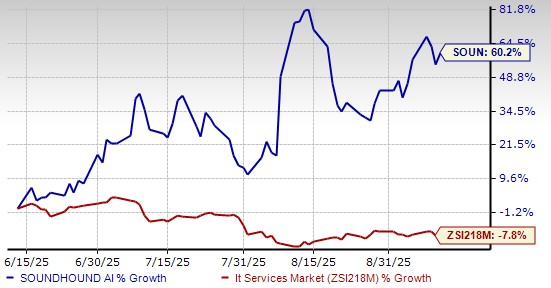
Image Source: Zacks Investment Research
In terms of its forward 12-month price-to-sales ratio, SOUN is trading at 29.71, up from the industry’s 17.05.
P/S (F12M)

Image Source: Zacks Investment Research
Over the past 60 days, the Zacks Consensus Estimate for SOUN’s 2025 loss per share has narrowed to 13 cents from 16 cents. The estimated figure indicates an improvement from the year-ago loss of $1.04 per share.
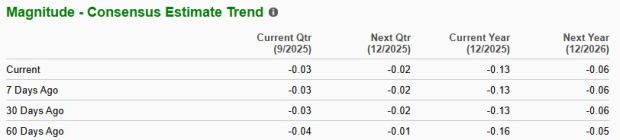
Image Source: Zacks Investment Research
SOUN currently carries a Zacks Rank #3 (Hold). You can see the complete list of today’s Zacks #1 Rank (Strong Buy) stocks here.
See our %%CTA_TEXT%% report – free today!
7 Best Stocks for the Next 30 Days
Amazon.com, Inc. (AMZN) : Free Stock Analysis Report
Alphabet Inc. (GOOGL) : Free Stock Analysis Report
SoundHound AI, Inc. (SOUN) : Free Stock Analysis Report
This article originally published on Zacks Investment Research (zacks.com).
5 Stocks Our Experts Predict Could Double In the Next Year
By submitting your email, you'll also get a free pivot & flow membership. A free daily market overview. You can unsubscribe at any time.