How much weight should we give to Wall Street analysts’ recommendations when considering investment options? Do these recommendations truly hold sway over a stock’s trajectory? These are the questions swirling around the financial world, particularly in relation to one of the most talked-about stocks, Alibaba (BABA).
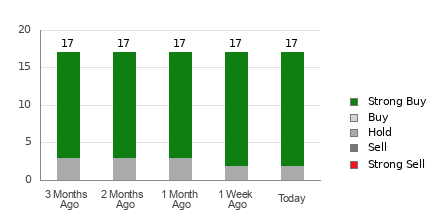
Currently, Alibaba boasts an Average Brokerage Recommendation (ABR) score of 1.24, based on assessments from 17 brokerage firms. This figure falls between Strong Buy and Buy on a scale ranging from 1 to 5. Among the 17 recommendations that contribute to this score, a staggering 88.2% are Strong Buy ratings.
Shifting Analyst Sentiments towards BABA

The numerical allure of the ABR for Alibaba may seem enticing, but history warns us against our blind allegiance. Studies have shown that while these recommendations may impact stock prices, they have a limited track record when it comes to accurately predicting a stock’s future value.
So, why the skepticism? Bias. Analysts representing brokerage firms harbor vested interests that skew their recommendations, with a tendency to shower stocks with inflated positivity. For every “Strong Sell” endorsement, there are typically five “Strong Buy” recommendations. This stark contrast in evaluations reveals a misalignment of interests between institutional analysts and retail investors.
Given this reality, it is wise to use brokerage recommendations as a supplementary tool rather than the crux of your investment strategy. Instead, consider incorporating more robust predictors, such as the Zacks Rank, to inform your decisions.
The Zacks Rank, a trusted stock rating tool, segregates stocks into five categories, from Strong Buy to Strong Sell. This tool leverages earnings estimate revisions to gauge a stock’s short-term performance, offering a more reliable compass for investors’ choices. When paired with the ABR, the Zacks Rank can imbue your investment strategy with greater certainty.
See also <!DOCTYPE html><html lang="en"><head> <meta charset="UTF-8"> <meta http-equiv="X-UA-Compatible" content="IE=edge"> <meta name="viewport" content="width=device-width, initial-scale=1.0"> <title>Intel Corporation's Stock Struggles Amidst Earnings Woes</title></head><body> <article> <h2>The Downfall of Intel's Stock Post-Earnings Revelation</h2> <p>Intel Corporation (INTC), known for its stronghold in the semiconductor industry, recently unveiled a challenging second quarter that has left analysts and investors apprehensive about the company's future performance. The disappointing earnings report, marked by revenue declines, substantial job cuts, and the suspension of dividends, has triggered a cascade of lowered price targets and downgrades, casting a somber shadow over Intel's once-sturdy stock standing.</p> <h3><strong>Insight into Intel's Stock</strong></h3> <p>Based in Santa Clara, California, Intel Corporation (INTC) commands a market capitalization of $80.84 billion within the global semiconductor domain. Specializing in the production of an array of computing products like microprocessors, chipsets, and cutting-edge driver assistance systems for autonomous vehicles, Intel has seen a plummet of 62.2% in its year-to-date stock performance, vastly underperforming the general market.</p> <figure class="image"> <img src="https://barchart-news-media-prod.aws.barchart.com/EXCLSV/ed586c1f318b3500d3b3667a89855af6/ad_4nxfouj1hd1aclniwy8xxcngyxurty_fv9qxuk5e9kze39hlsrdflw9er6qazks3mw39ji5zxgylovjajskap25w1lnlm-cbtiepmjnf2f6tsnvupyldujn0fjh1y0rpcar3wf_7f6crng_3lr-yrebit9wnm%3Fkey%3D7fnw1yei4p_5660rqwtl6a"> <figcaption>www.barchart.com</figcaption> </figure> <h3><strong>The Abrupt Plummet of Intel's Shares Post-Q2 Reveal</strong></h3> <p>Following the recent investor call on August 1, Intel reported lower-than-anticipated Q2 results, issuing a lackluster Q3 forecast. Additionally, the tech giant revealed plans for a sizable reduction in its workforce by over 15% and the halting of dividend payments. Subsequently, Intel's shares nosedived by over 26% in the subsequent trading period.</p> <p>In Q2, Intel recorded total revenue of $12.8 billion, a slight 1% drop compared to the previous year, missing estimates by $150 million. While the company witnessed a 4% revenue growth in its Products unit, led by robust client computing gains offsetting modest declines in the data center segment, it failed to match the soaring growth experienced by its competitors in this domain.</p> <p>With the revenue dip year-over-year, the non-GAAP gross margin fell as well, dropping 1.1 percentage points to 38.7%, notably beneath the company's anticipated 43.5% mark. This decline, coupled with a 5% increase in operational expenses, saw the adjusted operating margin shrink to a mere 0.2%, a significant regression from the 3.5% reported in the prior year.</p> <h3><strong>Challenges Ahead: Lunar Lake's Looming Margins and Margin-Recovery Strategies</strong></h3> <p>Intel's woes deepen with the impending release of its Lunar Lake CPU in late Q3, a product lineup that is slated to face margin constraints. The limited adoption of Lunar Lake, influenced by its release timing, poses a significant obstacle to Intel's profit margins, necessitating the company to postpone its 60% margin target until 2026.</p> <p>On a more hopeful note, Intel is counting on its forthcoming 18A process products, like Panther Lake and Clearwater Forest, due to launch in the latter half of 2025, to revamp its profit margins. However, the benefits from these new products and processes are not expected to materialize until 2026.</p> <p>Marked by revenue and margin hurdles alongside substantial capital expenses and a hefty $48 billion debt load, Intel has embarked on an aggressive cost-reduction initiative. This involves a 15% slash in its 110,000-strong workforce, a more than 20% decrease in projected 2024 investments in new infrastructure, with spending now ranging between $25 billion and $27 billion.</p> </article></body></html></div><!DOCTYPE html><html><head><title>Intel Faces Investor Backlash</title></head><body>Intel's Dive into the Abyss: Investor Backlash After Dividend Suspension
Deciphering ABR vs Zacks Rank
Although both the ABR and Zacks Rank utilize a 1 to 5 scale, their underpinnings are radically distinct.
ABR solely hinges on brokerage recommendations, displayed in decimal form. In sharp contrast, the Zacks Rank operates on a quantitative model driven by earnings estimate revisions, presented in whole numbers.
While brokerage analysts’ optimism colors ABR scores, Zacks Rank prioritizes the trajectory of earnings estimate revisions linked to stock performance.
Moreover, the dynamic nature of earnings revisions ensures the timeliness of Zacks Rank insights, providing a real-time reflection of a stock’s potential price movements.
Unlike ABR, illustrative of a static stance, the Zacks Rank remains in constant flux, mirroring market dynamics as they unfold. This adaptability, underscored by its grounding in earnings estimates, grants the Zacks Rank a leading edge in providing actionable insights for investors.
Intrigued by Alibaba’s Potential?
Recent data highlights a positive trajectory for Alibaba with a 1.9% surge in the Zacks Consensus Estimate for the current year, now standing at $8.94.
This elevation in earnings estimates signals a collective optimism among analysts, paving the way for a potential upswing in Alibaba’s stock value. This upward momentum translates into a Zacks Rank #2 (Buy) for Alibaba, further bolstering the case for investment.
For investors seeking top-performing stocks, exploring Zacks Rank #1 (Strong Buy) selections can unveil lucrative opportunities in the market landscape.
Thus, while the Buy-equivalent ABR for Alibaba beckons, harmonizing it with the insightful Zacks Rank evaluations can enhance the precision of your investment decisions.