
Key Points
Though AMD stock has performed well over the past year, it has come under pressure in 2026 due to factors beyond its control.
The company discussed in this article has delivered significantly stronger gains than AMD, and it is still trading at a cheaper valuation.
The heavy investments in semiconductor manufacturing equipment this year should continue to be a tailwind for this company, potentially helping it overtake AMD’s market cap by year end.
- 10 stocks we like better than Lam Research ›
Shares of Advanced Micro Devices (NASDAQ: AMD) performed impressively over the past year, rising a healthy 95% as compared to the 65% gains clocked by the PHLX Semiconductor Sector index over this period.
However, the semiconductor stock has been under pressure in 2026. AMD is underperforming the broader index, losing 5% of its value so far this year. The poor performance seems a tad surprising given that AMD delivered a solid set of results and guidance recently. The company’s 2025 revenue increased by 35% over the prior year to $34.6 billion, while non-GAAP earnings were up by 26% to $4.17 per share.
Will AI create the world’s first trillionaire? Our team just released a report on the one little-known company, called an “Indispensable Monopoly” providing the critical technology Nvidia and Intel both need. Continue »
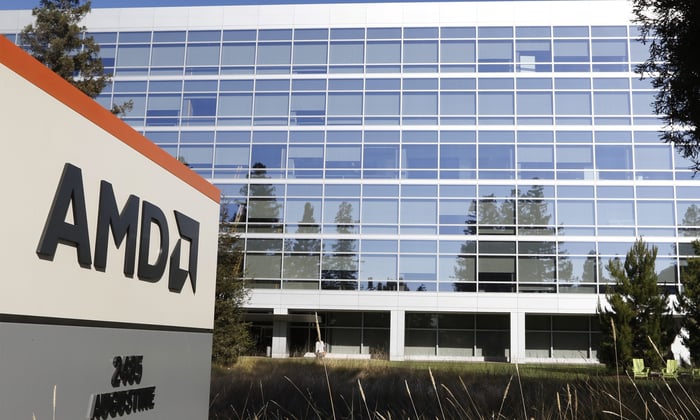
Image source: AMD.
However, investors anticipated stronger growth from AMD. That’s not surprising considering that the artificial intelligence (AI) chip market is growing at an incredible pace, and AMD’s peers have been clocking faster growth rates. Additionally, the impending threat to AMD’s server and client processor business from Nvidia, which is poised to sell its Grace server processors to Meta Platforms and laptop chips to Lenovo, seems to have further dented investor confidence in AMD stock.
That’s why it won’t be surprising to see Lam Research (NASDAQ: LRCX) stock outperform AMD in 2026, potentially becoming a bigger company than the latter by the end of the year. Let’s see why this is likely to be the case.
Lam Research has crushed AMD stock in the past year
Lam stock’s 192% jump in the past year has significantly outpaced the appreciation in AMD stock during this period. What’s more, Lam has already clocked impressive gains of 36.8% in 2026.
It is easy to see why that’s the case. The company sells semiconductor manufacturing equipment, and its offerings have been in great demand due to the ever-growing need for chips used in AI data centers. Investment banking firm Stifel anticipates an increase of 10% to 15% in wafer and fabrication equipment (WFE) spending in 2026, significantly raising its earlier forecast of 7% to 8%.
What’s more, Stifel estimates that Lam Research is poised to increase its revenue at a faster pace than the overall market this year. Consensus estimates suggest something similar, anticipating a 21% increase in its top-line in the current fiscal year to $22.37 billion. What’s more, analysts project a stronger jump of 23% in the company’s revenue in fiscal 2027.
However, don’t be surprised to see Lam exceeding estimates. There is a massive shortage of memory chips, and Lam gets a significant chunk of revenue from selling memory manufacturing equipment. Specifically, 23% of Lam’s revenue comes from selling dynamic random-access memory (DRAM) manufacturing equipment, while another 11% comes from the NAND segment.
There is a severe supply crunch of these memory chips in the market, with lead times extending into 2028. Not surprisingly, memory manufacturers such as Micron Technology and SK Hynix are focused on bringing additional capacity online. Also, the major hyperscalers are poised to spend a whopping $700 billion in 2026 to build more AI data centers.
All this is going to be a tailwind for Lam Research, as the company should ideally receive more orders in 2026 and clock better-than-expected growth in revenue.
Here’s why this semiconductor equipment manufacturer can overtake AMD
AMD currently has a market cap of $320 billion, which means that Lam Research isn’t very far behind AMD with a market cap of $304 billion. We have seen that Lam has significantly outperformed AMD in the past year. It won’t be surprising to see that trend continue in 2026, as Lam is poised to win from the huge AI data center spending since it sells the equipment that helps chipmakers manufacture chips.
AMD, however, has to compete with other chip designers for a share of the AI chip spending. So, Lam seems like the better pick-and-shovel play on AI infrastructure. Additionally, Lam is trading at a significantly cheaper 35 times earnings as compared to AMD’s earnings multiple of 101.
The cheaper valuation gives Lam room for more upside this year, especially considering that it doesn’t face the competitive pressures that AMD has to. So, there is a good chance of Lam being the better AI stock to buy in 2026, potentially paving the way for it to become a bigger company than AMD by the end of the year.
Should you buy stock in Lam Research right now?
Before you buy stock in Lam Research, consider this:
The Motley Fool Stock Advisor analyst team just identified what they believe are the 10 best stocks for investors to buy now… and Lam Research wasn’t one of them. The 10 stocks that made the cut could produce monster returns in the coming years.
Consider when Netflix made this list on December 17, 2004… if you invested $1,000 at the time of our recommendation, you’d have $445,995!* Or when Nvidia made this list on April 15, 2005… if you invested $1,000 at the time of our recommendation, you’d have $1,198,823!*
Now, it’s worth noting Stock Advisor’s total average return is 927% — a market-crushing outperformance compared to 194% for the S&P 500. Don’t miss the latest top 10 list, available with Stock Advisor, and join an investing community built by individual investors for individual investors.
*Stock Advisor returns as of February 27, 2026.
Harsh Chauhan has no position in any of the stocks mentioned. The Motley Fool has positions in and recommends Advanced Micro Devices, Lam Research, Meta Platforms, Micron Technology, and Nvidia. The Motley Fool has a disclosure policy.
5 Stocks Our Experts Predict Could Double In the Next Year
By submitting your email, you'll also get a free pivot & flow membership. A free daily market overview. You can unsubscribe at any time.