
Key Points
Owning Tesla (NASDAQ: TSLA) stock has always been a lively ride, with plenty of starts, stops, reversals, and the occasional detour into unfamiliar streets. So far this year, the bellwether electric vehicle (EV) maker’s stock has been traveling backward, with a more than 5% decline as of this writing. Does this drift into the discount lane make the shares a compelling buy, though?
P is for “pivot”…
A major factor behind Tesla’s stock slump is its fourth-quarter and full-year 2025 results published near the end of January. While it beat analyst estimates for both quarterly revenue and profitability, those fundamentals decreased year over year.
Where to invest $1,000 right now? Our analyst team just revealed what they believe are the 10 best stocks to buy right now, when you join Stock Advisor. See the stocks »
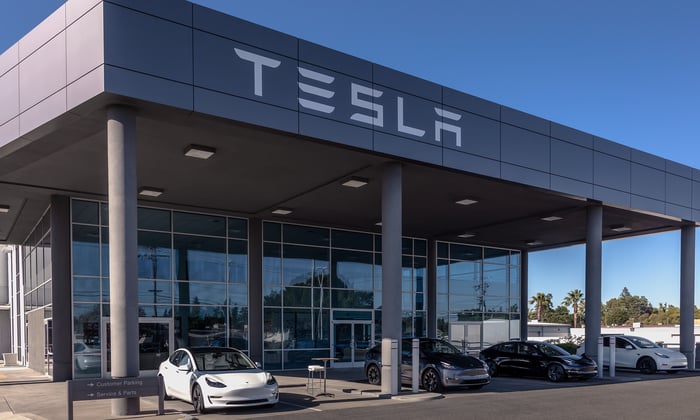
Image source: Tesla.
Worse, so did total deliveries, falling by 16% to 495,570. Since Tesla’s still primarily an automobile company (more on this in a moment), that was hardly an encouraging development.
At the same time, Tesla aims to ramp up spending considerably. Capex is expected to top $20 billion this year, more than double 2025’s level. Besides vehicle production, management wants to channel those funds into a range of projects, including the build-out of its proprietary battery technology, the CyberCab autonomous taxi and related Robotaxi system, and artificial intelligence (AI) efforts.
Notice that I didn’t specifically mention any of Tesla’s legacy car models. CEO and company figurehead Elon Musk did; he said Tesla will start winding down production of the high-end Model S sedan and the Model X SUV in the coming months. That’ll leave the far more modestly priced Models 3 and Y in Tesla’s inventory, plus the Cybertruck.
The word “pivot” wasn’t uttered in theearnings call but that’s sure what this feels like. The production space used for the Model S/X will switch to capacity for Optimus, the autonomous robot that’s been in development for years. Musk’s goal is to produce 1 million Optimuses (Optimi?) there annually.
The company hopes to start manufacturing the CyberCab in April. Musk grandly stated that “we would expect over time to make far more CyberCabs than all of our other vehicles combined.”
…and for “pricey”
Despite Tesla’s prominence as an EV maker, a pivot away from such products is sensible. Competition in the vehicle space has gotten tough and strong, and it’s likely to stay that way. So the future hinges on the potential of ventures like CyberCab, Optimus, and the optimistically named Full Self-Driving (FSD) Supervised platform — which, incidentally, is going to shift to a fully subscription-based model this quarter.
The thing is, Tesla remains awfully expensive on valuations. For example, the stock trades at a forward P/E of almost 205, with a bloated five-year PEG ratio of 6.8.
At those kinds of levels, the unproven Optimus and CyberCab would have to be irresistible, blockbuster products. Also, that battery manufacturing operation should be a world-beater. It would also help if those FSD subscriptions sold briskly, but we live in a world where many consumers already have more subscriptions than they can manage effectively.
It’s wise not to underestimate Musk personally and Tesla generally, and if any CEO and company has a chance of pulling this off, it’s them. Regardless, it’s a long shot even for the highest achievers, so I don’t consider Tesla to be a good investment now, even with the current price slump.
Don’t miss this second chance at a potentially lucrative opportunity
Ever feel like you missed the boat in buying the most successful stocks? Then you’ll want to hear this.
On rare occasions, our expert team of analysts issues a “Double Down” stock recommendation for companies that they think are about to pop. If you’re worried you’ve already missed your chance to invest, now is the best time to buy before it’s too late. And the numbers speak for themselves:
- Nvidia: if you invested $1,000 when we doubled down in 2009, you’d have $492,937!*
- Apple: if you invested $1,000 when we doubled down in 2008, you’d have $52,460!*
- Netflix: if you invested $1,000 when we doubled down in 2004, you’d have $429,385!*
Right now, we’re issuing “Double Down” alerts for three incredible companies, available when you join Stock Advisor, and there may not be another chance like this anytime soon.
*Stock Advisor returns as of February 12, 2026.
Eric Volkman has no position in any of the stocks mentioned. The Motley Fool has positions in and recommends Tesla. The Motley Fool has a disclosure policy.
5 Stocks Our Experts Predict Could Double In the Next Year
By submitting your email, you'll also get a free pivot & flow membership. A free daily market overview. You can unsubscribe at any time.