
Key Points
Warren Buffett retired on Dec. 31, handing the proverbial keys and control of Berkshire Hathaway’s day-to-day operations and investment portfolio to Greg Abel.
Buffett’s successor sold out of 16 positions (a third of Berkshire’s portfolio) in the first quarter, including high-profile stakes in Amazon, Domino’s Pizza, Visa, Mastercard, and UnitedHealth Group.
Though a few new names were welcomed, the big news is Berkshire’s now beefed-up $23 billion position in Google parent Alphabet.
- 10 stocks we like better than Alphabet ›
The trillion-dollar conglomerate that Warren Buffett built has entered a new era. On Dec. 31, Warren Buffett retired as CEO of Berkshire Hathaway (NYSE: BRKA)(NYSE: BRKB), handing the proverbial keys and control of the company’s day-to-day operations and mammoth investment portfolio over to Greg Abel.
Following the closing bell on Friday, May 15, Wall Street and investors got their first look at what an Abel-led portfolio might entail — and it involved a massive overhaul. Abel completely sold out of Amazon (NASDAQ: AMZN) and Domino’s Pizza (NASDAQ: DPZ), the latter of which had been purchased for six consecutive quarters, while more than tripling Berkshire’s stake in virtual monopoly Alphabet (NASDAQ: GOOGL)(NASDAQ: GOOG).
Will AI create the world’s first trillionaire? Our team just released a report on the one little-known company, called an “Indispensable Monopoly” providing the critical technology Nvidia and Intel both need. Continue »
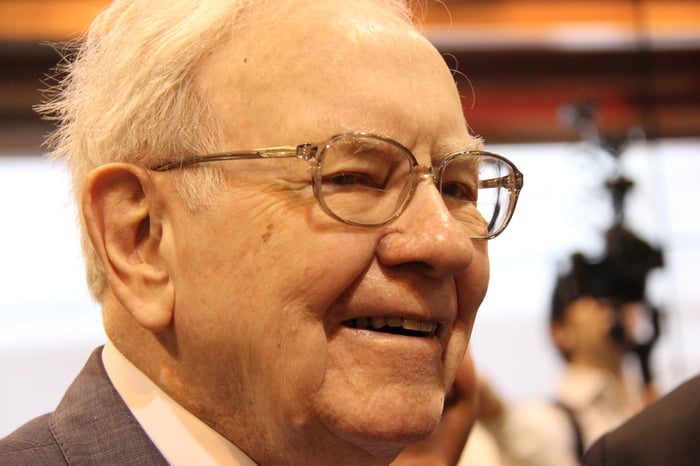
Warren Buffett retired as Berkshire Hathaway’s CEO on Dec. 31. Image source: The Motley Fool.
There’s no mistaking that this is Greg Abel’s portfolio now
When the dust cleared on April 1, Form 13F filings show that Abel completely exited 16 positions (a third of Berkshire’s portfolio, including its stakes in six Japanese stocks) during the first quarter.
The Amazon sale was, arguably, telegraphed following a 77% reduction in the December-ended quarter. Though Amazon possesses a sustainable moat and strong management team, something Abel and Berkshire’s former boss often looked for in great investments, it isn’t a screaming fundamental bargain, which is what Abel is seeking.
The sale of Domino’s Pizza stock is a true shock after six consecutive quarters of purchases. However, the adverse effects of inflation on consumers in the food industry may be at play. While Domino’s food speaks to value-conscious consumers, it nevertheless reported subpar same-store sales growth in the U.S. of 0.9% and an ultra-rare decline in international same-store sales (down 0.4%) in the first quarter.
In addition to Amazon and Domino’s, longtime holdings Visa and Mastercard were shown the door, UnitedHealth Group was dumped, and Berkshire’s stake in Chevron was cut by 35%.

Image source: Getty Images.
Warren Buffett’s successor piles into Google parent Alphabet
While there were a few notable new additions, including Delta Air Lines and department store retailer Macy’s, and a near-tripling in The New York Times Co., it’s Abel’s hand over fist buying of Google parent Alphabet that really stands out.
Abel more than tripled Berkshire Hathaway’s existing stake in the Class A shares (GOOGL) by purchasing 36,403,656 shares, and also added 3,585,215 Class C shares (GOOG). Collectively, Berkshire’s stake in Alphabet is worth approximately $23 billion, as of May 15.
Most investors are familiar with Google, which holds a virtual monopoly on internet search traffic (roughly 90% of worldwide traffic). But Alphabet is much more than search. It’s the parent of YouTube, the second-most-visited website behind Google, and is the brains behind the world’s No. 3 cloud infrastructure service platform by total spend, Google Cloud.
Google Cloud is the fastest growing hyperscaler in the entire world.
– Cloud Revenue: 63% YoY
– Cloud Backlog: 400% YoY
– Cloud Margin: 33%$GOOGL $GOOG pic.twitter.com/Tyfy0v1uBx— Qualtrim (@qualtrim) May 14, 2026
Alphabet’s incorporation of artificial intelligence solutions into Google Cloud has led to rapid acceleration in this segment’s high-margin growth rate (63% in the first quarter compared with the previous year).
Whereas Warren Buffett never really cared to delve into the inner workings of tech stocks, we’re seeing that his protégé isn’t afraid to dive in headfirst.
One thing is for certain: This isn’t your grandparents’ Berkshire Hathaway anymore.
Should you buy stock in Alphabet right now?
Before you buy stock in Alphabet, consider this:
The Motley Fool Stock Advisor analyst team just identified what they believe are the 10 best stocks for investors to buy now… and Alphabet wasn’t one of them. The 10 stocks that made the cut could produce monster returns in the coming years.
Consider when Netflix made this list on December 17, 2004… if you invested $1,000 at the time of our recommendation, you’d have $468,861!* Or when Nvidia made this list on April 15, 2005… if you invested $1,000 at the time of our recommendation, you’d have $1,445,212!*
Now, it’s worth noting Stock Advisor’s total average return is 1,013% — a market-crushing outperformance compared to 210% for the S&P 500. Don’t miss the latest top 10 list, available with Stock Advisor, and join an investing community built by individual investors for individual investors.
*Stock Advisor returns as of May 15, 2026.
Sean Williams has positions in Alphabet, Amazon, Mastercard, and Visa. The Motley Fool has positions in and recommends Alphabet, Amazon, Berkshire Hathaway, Chevron, Domino’s Pizza, Mastercard, The New York Times Co., and Visa. The Motley Fool recommends Delta Air Lines and UnitedHealth Group. The Motley Fool has a disclosure policy.
5 Stocks Our Experts Predict Could Double In the Next Year
By submitting your email, you'll also get a free pivot & flow membership. A free daily market overview. You can unsubscribe at any time.