
Key Points
Amazon helped establish Rivian with its order of 100,000 electric delivery vans (EDVs).
After ending the exclusivity agreement between the two companies, additional orders have been slow.
With improved EDV performance and better unit economics, Rivian is poised to take on more orders soon.
- 10 stocks we like better than Rivian Automotive ›
Last year was a transitional year for Rivian Automotive (NASDAQ: RIVN) and its investors. It was a strategic shift to focus on cost-cutting, factory retooling, and preparing for the highly anticipated launch of its lower-priced R2 model.
That left investors grappling with annual declines in production and deliveries, along with muted marketing at a time that the electric vehicle (EV) industry was already slowing down after the end of the $7,500 EV tax credit and other policy changes. With 2026 now in full swing, not only do investors have the R2 launch to digest, it’s worth remembering there’s still a potential catalyst many have forgotten.
Will AI create the world’s first trillionaire? Our team just released a report on the one little-known company, called an “Indispensable Monopoly” providing the critical technology Nvidia and Intel both need. Continue »
From big disappointment to big business?
For many, investors Rivian became more of a household name when Amazon (NASDAQ: AMZN) ordered 100,000 of its electric delivery vans (EDVs) and put the young EV maker on the map. Amazon initially funded the development of the EDV, and in return Rivian signed a four-year exclusivity deal. That agreement was amended in 2023 to allow the company to begin selling EDVs to other commercial customers.
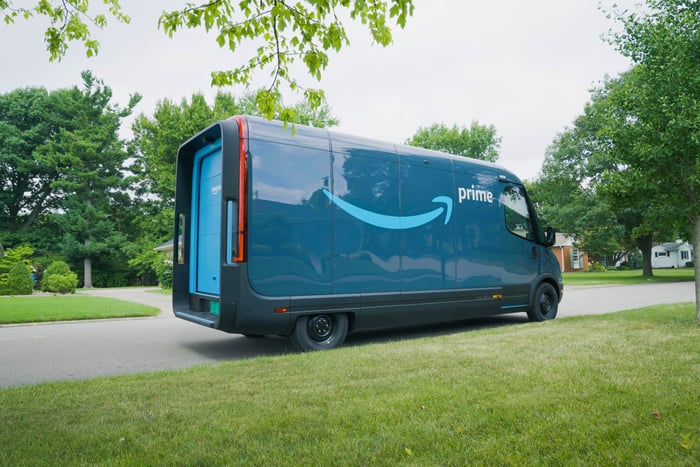
Image source: Rivian.
Investors such as myself imagined more big Amazon-like orders shuffling in, but that wasn’t the case. There are reasons for Rivian’s slow start with EDVs, including component shortages that challenged its ability to fill orders beyond Amazon.
Another factor holding it back was simply economics. It takes time for a fleet operator’s decision to switch to EVs to pay off, and that means a lower price tag for the vehicles is important.
Rivian’s EDVs check in around $80,000, while a competitor such as Ford Motor Company can offer E-Transits at a significantly cheaper price, in the mid $50,000s. Taking that a step further, Ford also offers a well-developed service and maintenance infrastructure, whereas Rivian is still building one.
Yet another factor for investors to consider is that often these large fleet operators will need to build some charging infrastructure themselves, which takes time and planning. That’s after the operators test the Rivian vehicles in a pilot program for an extended period of time. And it was better for the EV maker to complete cost-cutting on low-hanging fruit and improve the unit economics before signing more big fleet orders.
The upside
One factor that management is poised to improve upon is the EDV’s performance, which should help attract more buyers. The initial EDV model comes only with front-wheel-drive, 320 horsepower, and a battery pack that is quoted for a range of 161 miles. The company is easing those limitations by adding a larger battery pack to the EDV, which should increase its range by 30%, as well as giving the vehicle all-wheel-drive.
For investors, Rivian has worked diligently to cut costs and achieved its first full-year gross profit in 2025. It’s improving the performance and range of the EDV and has had time to help potential customers with pilot programs. It’s time for the EV maker to turn arguably what is its biggest disappointment into big business over the next year and a half.
Should you buy stock in Rivian Automotive right now?
Before you buy stock in Rivian Automotive, consider this:
The Motley Fool Stock Advisor analyst team just identified what they believe are the 10 best stocks for investors to buy now… and Rivian Automotive wasn’t one of them. The 10 stocks that made the cut could produce monster returns in the coming years.
Consider when Netflix made this list on December 17, 2004… if you invested $1,000 at the time of our recommendation, you’d have $518,530!* Or when Nvidia made this list on April 15, 2005… if you invested $1,000 at the time of our recommendation, you’d have $1,069,165!*
Now, it’s worth noting Stock Advisor’s total average return is 915% — a market-crushing outperformance compared to 183% for the S&P 500. Don’t miss the latest top 10 list, available with Stock Advisor, and join an investing community built by individual investors for individual investors.
*Stock Advisor returns as of April 2, 2026.
Daniel Miller has positions in Ford Motor Company. The Motley Fool has positions in and recommends Amazon. The Motley Fool has a disclosure policy.
5 Stocks Our Experts Predict Could Double In the Next Year
By submitting your email, you'll also get a free pivot & flow membership. A free daily market overview. You can unsubscribe at any time.