
Here’s a quick recap of the crypto landscape for Friday (November 28) as of 9:00 p.m. UTC.
Get the latest insights on Bitcoin, Ether and altcoins, along with a round-up of key cryptocurrencymarket news
Bitcoin and Ether price update
Bitcoin (BTC) was priced at US$91,192.19, down by 0.2 percent over 24 hours.
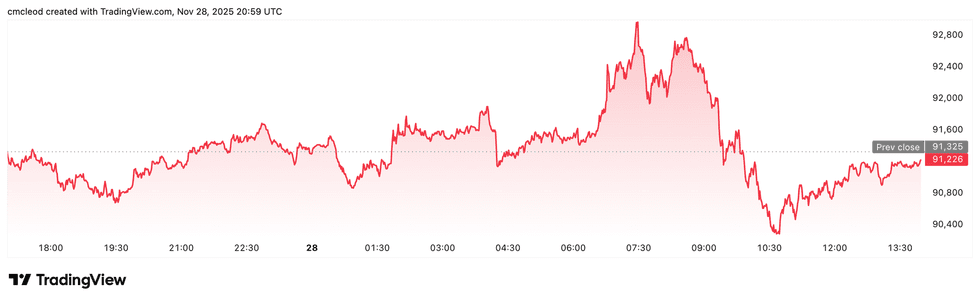
Chart via TradingView.
Bitcoin price performance, November 28, 2025.
After two straight sessions of gains, Bitcoin is maintaining a steady price point above US$91,000, having recovered from the lows of last week. In an email to the Investing News Network, Samer Hasn, market analyst at XS.com, said Bitcoin’s rebound is being powered by a broader recovery across global equities, particularly technology stocks, as fears around an artificial intelligence bubble have lessened, helping risk assets find firmer footing.
However, the expert added that whale selling is keeping upside momentum fragile, preventing Bitcoin’s recovery from becoming a sustained trend. Hasn also noted that while derivatives market indicators show some stabilization, the rebound lacks the aggressive leverage buildup that typically supports strong rallies.
Friday’s derivatives data reinforces this view. Open interest fell 0.13 percent over four hours as traders trimmed positions. Liquidations hit US$23.74 million, mostly in longs, clearing excess bets without sparking fresh buying.
The slightly negative funding rate of -0.001 percent shows shorts paying longs with no bullish premium, while Bitcoin’s relative strength index of 58 signals neutral momentum, not the overextension needed for a strong rally.
As Hasn explained:
“Bitcoin’s resilience this week is therefore being shaped by a supportive macro environment rather than internal strength. The mixed whale distribution pattern and the lack of sustained accumulation still underline that the market remains vulnerable. The next phase will likely depend on whether improving sentiment in equities can translate into more durable inflows across the crypto market.”
Meanwhile, Ether (ETH) was at US$3,057.17, up by 0.7 percent over 24 hours. Ether derivatives showed balanced consolidation: US$8.83 million in mixed long/short liquidations cleared positions evenly, while a 0.06 percent rise in open interest signals modest new bets. However, neutral funding at 0.001 percent lacks a bullish premium.
Altcoin price update
- XRP (XRP) was priced at US$2.19, down by 1.8 percent over 24 hours.
- Solana (SOL) was trading at US$137.88, down by 3.3 percent over 24 hours.
Fear and Greed Index snapshot
CMC’s Crypto Fear & Greed Index continued to climb steadily after plunging into “extreme fear” territory in the last two weeks. It has currently settled at 20 and is inching closer to “fear.”
Bitcoin’s rebound from the mid-US$80,000 zone has triggered a swift shift in market sentiment. After the price briefly cooled near US$80,000, many expected a sluggish recovery phase. Instead, optimism snapped back, with the sentiment index rising 10 points over the week and marking one of its sharpest moves in recent months.
The increase corresponds with heavier buying activity and reduced caution among traders who had previously stayed on the sidelines during the cryptocurrency’s pullback.
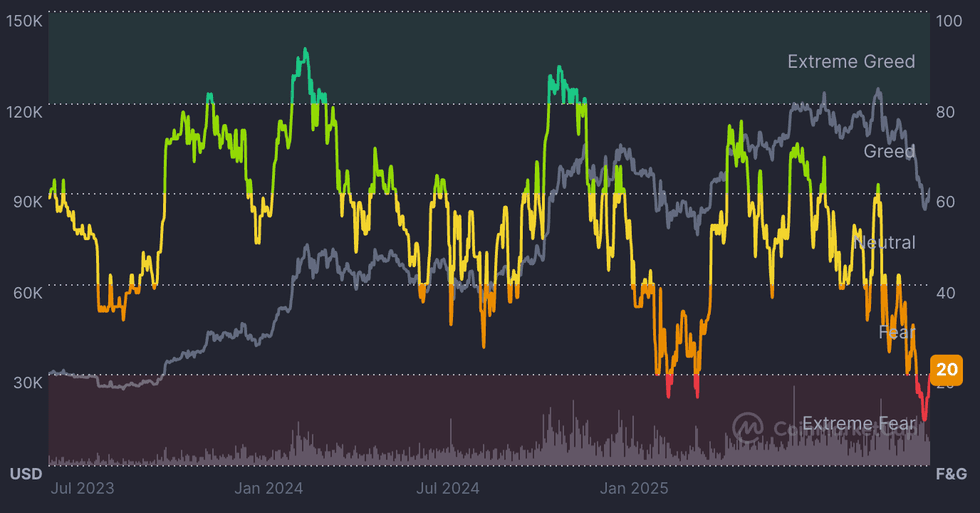
Chart via CoinMarketCap.
CMC Crypto Fear and Greed Index, Bitcoin price and Bitcoin volume.
Today’s crypto news to know
Major CME Group outage halts futures trading
CME Group (NASDAQ:CME) experienced a major outage on Friday due to a chiller plant malfunction at the CyrusOne CHI1 facility, halting trading in futures and options across equities, currencies, commodities, treasuries and FOREX.
The disruption started late on Thursday (November 27) and affected the Globex platform, which handles 90 percent of CME Group’s volume. The outage halted trading in Bitcoin and Ether futures for about nine to 11 hours, disrupting access to quotes and positions, but leaving spot crypto markets largely unaffected.
Visa expands stablecoin settlement push with Aquanow partnership
Visa (NYSE:V) has deepened its stablecoin strategy by teaming up with Aquanow to support faster settlement across Central and Eastern Europe, the Middle East and Africa.
The deal plugs Aquanow’s infrastructure directly into Visa’s payment rails, allowing banks and payment firms in the region to settle transactions in approved stablecoins such as USDC.
Visa says the upgrade is aimed at institutions seeking cheaper and quicker cross-border settlement options as demand for digital asset rails grows. The company also aims to modernize the “back-end plumbing” of payments by reducing reliance on traditional networks with multiple intermediaries. Aquanow, which processes billions in crypto transactions each month, will provide liquidity and technical support for the integrations.
The collaboration follows Visa’s recent stablecoin payout pilot, Visa Direct, which lets businesses fund transactions in fiat while recipients opt to receive stablecoins directly in their wallets.
UK backs “no gain, no loss” tax model for DeFi activity
The UK government has endorsed a major shift in how DeFi transactions are taxed, moving to eliminate capital gains charges when users deposit tokens into lending protocols or liquidity pools.
Under the current rules, deposits can be treated as disposals, often generating tax liabilities even when investors haven’t realized any economic gain. HM Revenue & Customs’ updated guidance supports a “no gain, no loss” approach that would tax users only when they withdraw assets and eventually sell them.
The proposal comes after two years of industry feedback from firms, many of which argued that the existing system distorts reality and burdens ordinary users with excessive record keeping. The new model would apply to both simple lending and automated market makers, ensuring that only genuine gains or losses are captured for tax purposes.
Australia introduces digital assets bill
Australia has tabled a new digital assets bill aimed at ending years of regulatory uncertainty and preventing a repeat of past offshore failures such as FTX and Celsius.
The proposed Corporations Amendment (Digital Assets Framework) Bill 2025 would require platforms holding customer crypto to meet the same licensing and conduct standards applied across the financial sector.
Officials said the legislation is designed to bring crypto businesses fully into the regulated economy, ensuring transparency, custody safeguards and clear accountability.
The bill includes exemptions for smaller operators that process under US$10 million annually and hold less than US$5,000 per customer, mirroring existing thresholds for low-risk financial products. The government argues that modernizing the rules could unlock as much as US$24 billion a year in productivity and efficiency gains.
Don’t forget to follow us @INN_Technology for real-time news updates!
Securities Disclosure: I, Giann Liguid, hold no direct investment interest in any company mentioned in this article.
Securities Disclosure: I, Meagen Seatter, hold no direct investment interest in any company mentioned in this article.
Editorial Disclosure: The Investing News Network does not guarantee the accuracy or thoroughness of the information reported in the interviews it conducts. The opinions expressed in these interviews do not reflect the opinions of the Investing News Network and do not constitute investment advice. All readers are encouraged to perform their own due diligence.
5 Stocks Our Experts Predict Could Double In the Next Year
By submitting your email, you'll also get a free pivot & flow membership. A free daily market overview. You can unsubscribe at any time.